Shapefile export demo
The goal of this notebook is to demonstrate ways to export model information to shapefiles. This example will cover: * basic exporting of information for a model, individual package, or dataset * custom exporting of combined data from different packages * general exporting and importing of geographic data from other sources
[1]:
import os
[2]:
import sys
from tempfile import TemporaryDirectory

import matplotlib as mpl
import matplotlib.pyplot as plt
import numpy as np
import pandas as pd

import flopy

print(sys.version)
print(f"numpy version: {np.__version__}")
print(f"matplotlib version: {mpl.__version__}")
print(f"flopy version: {flopy.__version__}")
3.12.5 | packaged by conda-forge | (main, Aug  8 2024, 18:36:51) [GCC 12.4.0]
numpy version: 2.1.0
matplotlib version: 3.9.2
flopy version: 3.8.1
[3]:
# temporary directory
temp_dir = TemporaryDirectory()
outdir = os.path.join(temp_dir.name, "shapefile_export")

# load an existing model
model_ws = "../../examples/data/freyberg"
m = flopy.modflow.Modflow.load(
    "freyberg.nam",
    model_ws=model_ws,
    verbose=False,
    check=False,
    exe_name="mfnwt",
)
[4]:
m.get_package_list()
[4]:
['DIS', 'BAS6', 'LPF', 'WEL', 'RIV', 'RCH', 'OC', 'PCG']
set the model coordinate information
the coordinate information where the grid is located in a projected coordinate system (e.g. UTM)
[5]:
grid = m.modelgrid
grid.set_coord_info(xoff=273170, yoff=5088657, crs=26916)
[6]:
grid.extent
[6]:
(np.float64(273170.0),
 np.float64(278170.0),
 np.float64(5088657.0),
 np.float64(5098657.0))
Declarative export using attached .export() methods
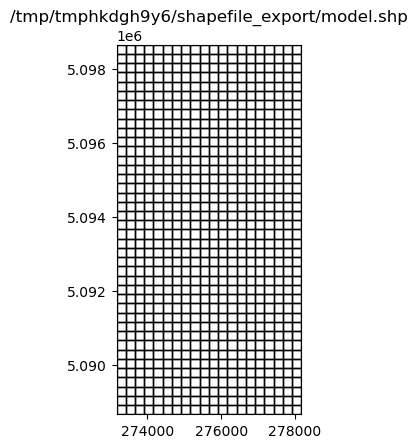
Export the whole model to a single shapefile
[7]:
fname = f"{outdir}/model.shp"
m.export(fname)
/home/runner/micromamba/envs/flopy/lib/python3.12/site-packages/flopy/export/shapefile_utils.py:319: UserWarning: Failed to get data for delc array, DIS package
  warn(
/home/runner/micromamba/envs/flopy/lib/python3.12/site-packages/flopy/export/shapefile_utils.py:319: UserWarning: Failed to get data for delr array, DIS package
  warn(
/home/runner/micromamba/envs/flopy/lib/python3.12/site-packages/flopy/export/shapefile_utils.py:319: UserWarning: Failed to get data for laycbd array, DIS package
  warn(
/home/runner/micromamba/envs/flopy/lib/python3.12/site-packages/flopy/export/shapefile_utils.py:319: UserWarning: Failed to get data for nstp array, DIS package
  warn(
/home/runner/micromamba/envs/flopy/lib/python3.12/site-packages/flopy/export/shapefile_utils.py:319: UserWarning: Failed to get data for perlen array, DIS package
  warn(
/home/runner/micromamba/envs/flopy/lib/python3.12/site-packages/flopy/export/shapefile_utils.py:319: UserWarning: Failed to get data for steady array, DIS package
  warn(
/home/runner/micromamba/envs/flopy/lib/python3.12/site-packages/flopy/export/shapefile_utils.py:319: UserWarning: Failed to get data for tsmult array, DIS package
  warn(
/home/runner/micromamba/envs/flopy/lib/python3.12/site-packages/flopy/export/shapefile_utils.py:319: UserWarning: Failed to get data for chani array, LPF package
  warn(
/home/runner/micromamba/envs/flopy/lib/python3.12/site-packages/flopy/export/shapefile_utils.py:319: UserWarning: Failed to get data for layavg array, LPF package
  warn(
/home/runner/micromamba/envs/flopy/lib/python3.12/site-packages/flopy/export/shapefile_utils.py:319: UserWarning: Failed to get data for laytyp array, LPF package
  warn(
/home/runner/micromamba/envs/flopy/lib/python3.12/site-packages/flopy/export/shapefile_utils.py:319: UserWarning: Failed to get data for layvka array, LPF package
  warn(
/home/runner/micromamba/envs/flopy/lib/python3.12/site-packages/flopy/export/shapefile_utils.py:319: UserWarning: Failed to get data for laywet array, LPF package
  warn(
[8]:
ax = plt.subplot(1, 1, 1, aspect="equal")
extents = grid.extent
pc = flopy.plot.plot_shapefile(fname, ax=ax, edgecolor="k", facecolor="none")
ax.set_xlim(extents[0], extents[1])
ax.set_ylim(extents[2], extents[3])
ax.set_title(fname)
[8]:
Text(0.5, 1.0, '/tmp/tmphkdgh9y6/shapefile_export/model.shp')
[9]:
fname = f"{outdir}/wel.shp"
m.wel.export(fname)
Export a package to a shapefile
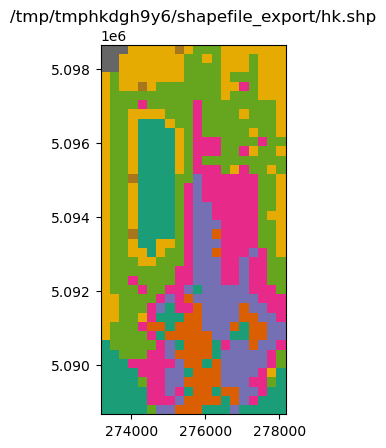
Export a FloPy list or array object
[10]:
m.lpf.hk
[10]:
<flopy.utils.util_array.Util3d at 0x7f4a90c407d0>
[11]:
fname = f"{outdir}/hk.shp"
m.lpf.hk.export(f"{outdir}/hk.shp")
[12]:
ax = plt.subplot(1, 1, 1, aspect="equal")
extents = grid.extent
a = m.lpf.hk.array.ravel()
pc = flopy.plot.plot_shapefile(fname, ax=ax, a=a)
ax.set_xlim(extents[0], extents[1])
ax.set_ylim(extents[2], extents[3])
ax.set_title(fname)
[12]:
Text(0.5, 1.0, '/tmp/tmphkdgh9y6/shapefile_export/hk.shp')
[13]:
m.riv.stress_period_data
[13]:
<flopy.utils.util_list.MfList at 0x7f4a90c40d10>
[14]:
m.riv.stress_period_data.export(f"{outdir}/riv_spd.shp")
MfList.export() exports the whole grid by default, regardless of the locations of the boundary cells
sparse=True only exports the boundary cells in the MfList
[15]:
m.riv.stress_period_data.export(f"{outdir}/riv_spd.shp", sparse=True)
[16]:
m.wel.stress_period_data.export(f"{outdir}/wel_spd.shp", sparse=True)
Ad-hoc exporting using recarray2shp
The main idea is to create a recarray with all of the attribute information, and a list of geometry features (one feature per row in the recarray)
each geometry feature is an instance of the
Point,LineStringorPolygonclasses inflopy.utils.geometry. The shapefile format requires all the features to be of the same type.We will use pandas dataframes for these examples because they are easy to work with, and then convert them to recarrays prior to exporting.
[17]:
from flopy.export.shapefile_utils import recarray2shp
combining data from different packages
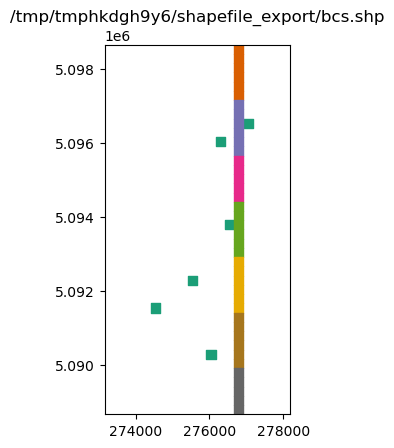
write a shapefile of RIV and WEL package cells
[18]:
wellspd = pd.DataFrame(m.wel.stress_period_data[0])
rivspd = pd.DataFrame(m.riv.stress_period_data[0])
spd = pd.concat([wellspd, rivspd])
spd.head()
[18]:
| k | i | j | flux | iface | stage | cond | rbot | |
|---|---|---|---|---|---|---|---|---|
| 0 | 0 | 8 | 15 | -0.00820 | 0.0 | NaN | NaN | NaN |
| 1 | 0 | 10 | 12 | -0.00410 | 0.0 | NaN | NaN | NaN |
| 2 | 0 | 19 | 13 | -0.00390 | 0.0 | NaN | NaN | NaN |
| 3 | 0 | 25 | 9 | -0.00083 | 0.0 | NaN | NaN | NaN |
| 4 | 0 | 28 | 5 | -0.00072 | 0.0 | NaN | NaN | NaN |
[19]:
from flopy.utils.geometry import Polygon

vertices = []
for row, col in zip(spd.i, spd.j):
    vertices.append(grid.get_cell_vertices(row, col))
polygons = [Polygon(vrt) for vrt in vertices]
polygons
[19]:
[<flopy.utils.geometry.Polygon at 0x7f4a907ecb00>,
 <flopy.utils.geometry.Polygon at 0x7f4a907ec350>,
 <flopy.utils.geometry.Polygon at 0x7f4a907ec230>,
 <flopy.utils.geometry.Polygon at 0x7f4a907ec560>,
 <flopy.utils.geometry.Polygon at 0x7f4a907ecb30>,
 <flopy.utils.geometry.Polygon at 0x7f4a907ec590>,
 <flopy.utils.geometry.Polygon at 0x7f4a907ec3e0>,
 <flopy.utils.geometry.Polygon at 0x7f4a907ecc50>,
 <flopy.utils.geometry.Polygon at 0x7f4a907ec2c0>,
 <flopy.utils.geometry.Polygon at 0x7f4a907ecb90>,
 <flopy.utils.geometry.Polygon at 0x7f4a907ecdd0>,
 <flopy.utils.geometry.Polygon at 0x7f4a907ece60>,
 <flopy.utils.geometry.Polygon at 0x7f4a907ecf20>,
 <flopy.utils.geometry.Polygon at 0x7f4a907ecf80>,
 <flopy.utils.geometry.Polygon at 0x7f4a907ed1f0>,
 <flopy.utils.geometry.Polygon at 0x7f4a907ed280>,
 <flopy.utils.geometry.Polygon at 0x7f4a907ed310>,
 <flopy.utils.geometry.Polygon at 0x7f4a907ed3a0>,
 <flopy.utils.geometry.Polygon at 0x7f4a907ed430>,
 <flopy.utils.geometry.Polygon at 0x7f4a907ed4c0>,
 <flopy.utils.geometry.Polygon at 0x7f4a907ed550>,
 <flopy.utils.geometry.Polygon at 0x7f4a907ed5e0>,
 <flopy.utils.geometry.Polygon at 0x7f4a907ed670>,
 <flopy.utils.geometry.Polygon at 0x7f4a907ed700>,
 <flopy.utils.geometry.Polygon at 0x7f4a907ed790>,
 <flopy.utils.geometry.Polygon at 0x7f4a907ed820>,
 <flopy.utils.geometry.Polygon at 0x7f4a907ed8b0>,
 <flopy.utils.geometry.Polygon at 0x7f4a907ed940>,
 <flopy.utils.geometry.Polygon at 0x7f4a907ed9d0>,
 <flopy.utils.geometry.Polygon at 0x7f4a907eda60>,
 <flopy.utils.geometry.Polygon at 0x7f4a907edaf0>,
 <flopy.utils.geometry.Polygon at 0x7f4a907edb80>,
 <flopy.utils.geometry.Polygon at 0x7f4a907edc10>,
 <flopy.utils.geometry.Polygon at 0x7f4a907edca0>,
 <flopy.utils.geometry.Polygon at 0x7f4a907edd30>,
 <flopy.utils.geometry.Polygon at 0x7f4a907eddc0>,
 <flopy.utils.geometry.Polygon at 0x7f4a907ede50>,
 <flopy.utils.geometry.Polygon at 0x7f4a907edee0>,
 <flopy.utils.geometry.Polygon at 0x7f4a907edf70>,
 <flopy.utils.geometry.Polygon at 0x7f4a907ee000>,
 <flopy.utils.geometry.Polygon at 0x7f4a907ee090>,
 <flopy.utils.geometry.Polygon at 0x7f4a907ee120>,
 <flopy.utils.geometry.Polygon at 0x7f4a907ee1b0>,
 <flopy.utils.geometry.Polygon at 0x7f4a907ee240>,
 <flopy.utils.geometry.Polygon at 0x7f4a907ee2d0>,
 <flopy.utils.geometry.Polygon at 0x7f4a907ee360>]
[20]:
fname = f"{outdir}/bcs.shp"
recarray2shp(spd.to_records(), geoms=polygons, shpname=fname, crs=grid.epsg)
[21]:
ax = plt.subplot(1, 1, 1, aspect="equal")
extents = grid.extent
pc = flopy.plot.plot_shapefile(fname, ax=ax)
ax.set_xlim(extents[0], extents[1])
ax.set_ylim(extents[2], extents[3])
ax.set_title(fname)
[21]:
Text(0.5, 1.0, '/tmp/tmphkdgh9y6/shapefile_export/bcs.shp')
exporting other data
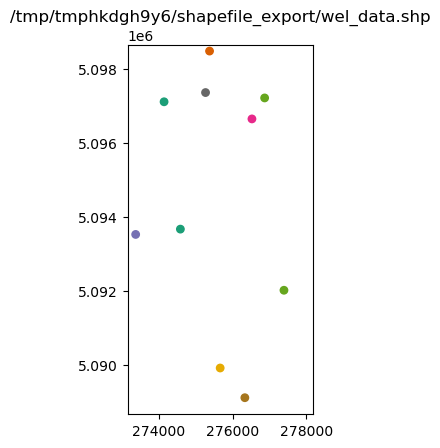
Suppose we have some well data with actual locations that we want to export to a shapefile
[22]:
welldata = pd.DataFrame(
    {
        "wellID": np.arange(0, 10),
        "q": np.random.randn(10) * 100 - 1000,
        "x_utm": np.random.rand(10) * 5000 + grid.xoffset,
        "y_utm": grid.yoffset + np.random.rand(10) * 10000,
    }
)
welldata.head()
[22]:
| wellID | q | x_utm | y_utm | |
|---|---|---|---|---|
| 0 | 0 | -1043.960901 | 274148.312327 | 5.097112e+06 |
| 1 | 1 | -1023.794620 | 274589.655406 | 5.093667e+06 |
| 2 | 2 | -983.827382 | 275378.803076 | 5.098484e+06 |
| 3 | 3 | -1148.416268 | 273379.672683 | 5.093523e+06 |
| 4 | 4 | -1190.611024 | 276525.706170 | 5.096648e+06 |
[23]:
from flopy.utils.geometry import Point

geoms = [Point(x, y) for x, y in zip(welldata.x_utm, welldata.y_utm)]

fname = f"{outdir}/wel_data.shp"
recarray2shp(welldata.to_records(), geoms=geoms, shpname=fname, crs=grid.epsg)
[24]:
ax = plt.subplot(1, 1, 1, aspect="equal")
extents = grid.extent
pc = flopy.plot.plot_shapefile(fname, ax=ax, radius=100)
ax.set_xlim(extents[0], extents[1])
ax.set_ylim(extents[2], extents[3])
ax.set_title(fname)
[24]:
Text(0.5, 1.0, '/tmp/tmphkdgh9y6/shapefile_export/wel_data.shp')
Adding attribute data to an existing shapefile
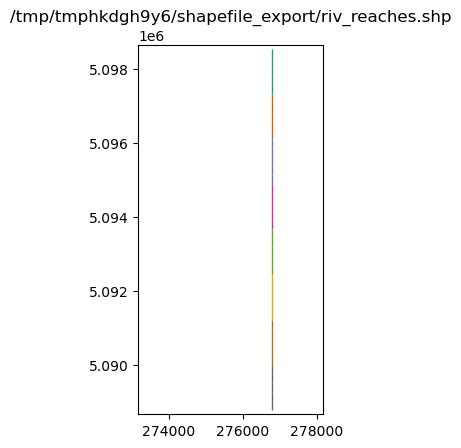
Suppose we have a GIS coverage representing the river in the riv package
[25]:
from flopy.utils.geometry import LineString

### make up a linestring shapefile of the river reaches
i, j = m.riv.stress_period_data[0].i, m.riv.stress_period_data[0].j
x0 = grid.xyzcellcenters[0][i[0], j[0]]
x1 = grid.xyzcellcenters[0][i[-1], j[-1]]
y0 = grid.xyzcellcenters[1][i[0], j[0]]
y1 = grid.xyzcellcenters[1][i[-1], j[-1]]
x = np.linspace(x0, x1, m.nrow + 1)
y = np.linspace(y0, y1, m.nrow + 1)
l0 = zip(list(zip(x[:-1], y[:-1])), list(zip(x[1:], y[1:])))
lines = [LineString(l) for l in l0]

rivdata = pd.DataFrame(m.riv.stress_period_data[0])
rivdata["reach"] = np.arange(len(lines))
lines_shapefile = f"{outdir}/riv_reaches.shp"
recarray2shp(
    rivdata.to_records(index=False),
    geoms=lines,
    shpname=lines_shapefile,
    crs=grid.epsg,
)
[26]:
ax = plt.subplot(1, 1, 1, aspect="equal")
extents = grid.extent
pc = flopy.plot.plot_shapefile(lines_shapefile, ax=ax, radius=25)
ax.set_xlim(extents[0], extents[1])
ax.set_ylim(extents[2], extents[3])
ax.set_title(lines_shapefile)
[26]:
Text(0.5, 1.0, '/tmp/tmphkdgh9y6/shapefile_export/riv_reaches.shp')
shp2recarray reads a shapefile into a numpy record array, which can easily be converted to a DataFrame
[27]:
from flopy.export.shapefile_utils import shp2recarray
[28]:
linesdata = shp2recarray(lines_shapefile)
linesdata = pd.DataFrame(linesdata)
linesdata.head()
[28]:
| k | i | j | stage | cond | rbot | iface | reach | geometry | |
|---|---|---|---|---|---|---|---|---|---|
| 0 | 0 | 0 | 14 | 20.100000 | 0.05 | 20.00 | 0.0 | 0 | <flopy.utils.geometry.LineString object at 0x7... |
| 1 | 0 | 1 | 14 | 19.870001 | 0.05 | 19.75 | 0.0 | 1 | <flopy.utils.geometry.LineString object at 0x7... |
| 2 | 0 | 2 | 14 | 19.650000 | 0.05 | 19.50 | 0.0 | 2 | <flopy.utils.geometry.LineString object at 0x7... |
| 3 | 0 | 3 | 14 | 19.420000 | 0.05 | 19.25 | 0.0 | 3 | <flopy.utils.geometry.LineString object at 0x7... |
| 4 | 0 | 4 | 14 | 19.190001 | 0.05 | 19.00 | 0.0 | 4 | <flopy.utils.geometry.LineString object at 0x7... |
[29]:
# make up some fluxes between the river and aquifer at each reach
q = np.random.randn(len(linesdata)) + 1
q
[29]:
array([ 0.3733417 ,  1.55200474,  0.69728781,  3.30299472,  1.41106304,
        0.24762923,  2.33724735,  0.9306728 ,  1.83987057,  0.73033869,
        0.9004142 ,  0.46086947,  0.8576054 ,  0.17617068, -0.32274156,
        2.62648181,  2.24234359, -0.01057331,  0.49170438, -0.34871364,
        0.52854513,  1.25951771,  0.57614206,  1.33933567,  0.75299772,
        1.27387896,  1.49188811,  2.21163679,  0.11383537,  2.39430562,
        0.62890895,  1.78682744,  0.78855643,  0.79052408,  0.92761477,
        1.40261382, -0.10652299,  0.75498096,  0.95103184,  0.1681    ])
[30]:
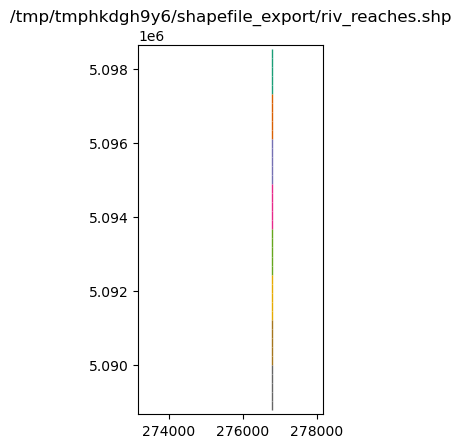
linesdata["qreach"] = q
linesdata["qstream"] = np.cumsum(q)
[31]:
recarray2shp(
    linesdata.drop("geometry", axis=1).to_records(),
    geoms=linesdata.geometry.values,
    shpname=lines_shapefile,
    crs=grid.epsg,
)
[32]:
ax = plt.subplot(1, 1, 1, aspect="equal")
extents = grid.extent
pc = flopy.plot.plot_shapefile(lines_shapefile, ax=ax, radius=25)
ax.set_xlim(extents[0], extents[1])
ax.set_ylim(extents[2], extents[3])
ax.set_title(lines_shapefile)
[32]:
Text(0.5, 1.0, '/tmp/tmphkdgh9y6/shapefile_export/riv_reaches.shp')
Overriding the model’s modelgrid with a user supplied modelgrid
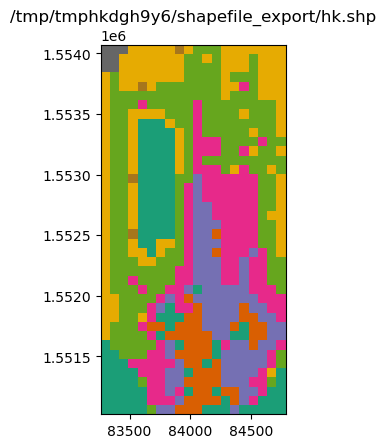
In some cases it may be necessary to override the model’s modelgrid instance with a seperate modelgrid. An example of this is if the model discretization is in feet and the user would like it projected in meters. Exporting can be accomplished by supplying a modelgrid as a kwarg in any of the export() methods within flopy. Below is an example:
[33]:
mg0 = m.modelgrid

# build a new modelgrid instance with discretization in meters
modelgrid = flopy.discretization.StructuredGrid(
    delc=mg0.delc * 0.3048,
    delr=mg0.delr * 0.3048,
    top=mg0.top,
    botm=mg0.botm,
    idomain=mg0.idomain,
    xoff=mg0.xoffset * 0.3048,
    yoff=mg0.yoffset * 0.3048,
)

# exporting an entire model
m.export(f"{outdir}/freyberg.shp", modelgrid=modelgrid)
No CRS information for writing a .prj file.
Supply an valid coordinate system reference to the attached modelgrid object or .export() method.
No CRS information for writing a .prj file.
Supply an valid coordinate system reference to the attached modelgrid object or .export() method.
/home/runner/micromamba/envs/flopy/lib/python3.12/site-packages/flopy/export/shapefile_utils.py:319: UserWarning: Failed to get data for delc array, DIS package
  warn(
/home/runner/micromamba/envs/flopy/lib/python3.12/site-packages/flopy/export/shapefile_utils.py:319: UserWarning: Failed to get data for delr array, DIS package
  warn(
/home/runner/micromamba/envs/flopy/lib/python3.12/site-packages/flopy/export/shapefile_utils.py:319: UserWarning: Failed to get data for laycbd array, DIS package
  warn(
/home/runner/micromamba/envs/flopy/lib/python3.12/site-packages/flopy/export/shapefile_utils.py:319: UserWarning: Failed to get data for nstp array, DIS package
  warn(
/home/runner/micromamba/envs/flopy/lib/python3.12/site-packages/flopy/export/shapefile_utils.py:319: UserWarning: Failed to get data for perlen array, DIS package
  warn(
/home/runner/micromamba/envs/flopy/lib/python3.12/site-packages/flopy/export/shapefile_utils.py:319: UserWarning: Failed to get data for steady array, DIS package
  warn(
/home/runner/micromamba/envs/flopy/lib/python3.12/site-packages/flopy/export/shapefile_utils.py:319: UserWarning: Failed to get data for tsmult array, DIS package
  warn(
/home/runner/micromamba/envs/flopy/lib/python3.12/site-packages/flopy/export/shapefile_utils.py:319: UserWarning: Failed to get data for chani array, LPF package
  warn(
/home/runner/micromamba/envs/flopy/lib/python3.12/site-packages/flopy/export/shapefile_utils.py:319: UserWarning: Failed to get data for layavg array, LPF package
  warn(
/home/runner/micromamba/envs/flopy/lib/python3.12/site-packages/flopy/export/shapefile_utils.py:319: UserWarning: Failed to get data for laytyp array, LPF package
  warn(
/home/runner/micromamba/envs/flopy/lib/python3.12/site-packages/flopy/export/shapefile_utils.py:319: UserWarning: Failed to get data for layvka array, LPF package
  warn(
/home/runner/micromamba/envs/flopy/lib/python3.12/site-packages/flopy/export/shapefile_utils.py:319: UserWarning: Failed to get data for laywet array, LPF package
  warn(
And for a specific parameter the method is the same
[34]:
fname = f"{outdir}/hk.shp"
m.lpf.hk.export(fname, modelgrid=modelgrid)
No CRS information for writing a .prj file.
Supply an valid coordinate system reference to the attached modelgrid object or .export() method.
[35]:
ax = plt.subplot(1, 1, 1, aspect="equal")
extents = modelgrid.extent
a = m.lpf.hk.array.ravel()
pc = flopy.plot.plot_shapefile(fname, ax=ax, a=a)
ax.set_xlim(extents[0], extents[1])
ax.set_ylim(extents[2], extents[3])
ax.set_title(fname)
[35]:
Text(0.5, 1.0, '/tmp/tmphkdgh9y6/shapefile_export/hk.shp')
[36]:
try:
    # ignore PermissionError on Windows
    temp_dir.cleanup()
except:
    pass