Postprocessing head results from MODFLOW
[1]:
import os
import sys
from pathlib import Path
from tempfile import TemporaryDirectory

import git
import matplotlib as mpl
import matplotlib.pyplot as plt
import numpy as np
import pooch

import flopy
import flopy.utils.binaryfile as bf
from flopy.utils.postprocessing import (
    get_gradients,
    get_transmissivities,
    get_water_table,
)

print(sys.version)
print(f"numpy version: {np.__version__}")
print(f"matplotlib version: {mpl.__version__}")
print(f"flopy version: {flopy.__version__}")
3.12.12 | packaged by conda-forge | (main, Jan 26 2026, 23:51:32) [GCC 14.3.0]
numpy version: 2.4.2
matplotlib version: 3.10.8
flopy version: 3.10.0
[2]:
mfnam = "EXAMPLE.nam"
heads_file = "EXAMPLE.HED"

# temporary directory
temp_dir = TemporaryDirectory()
workspace = temp_dir.name


# Check if we are in the repository and define the data path.

try:
    root = Path(git.Repo(".", search_parent_directories=True).working_dir)
except:
    root = None

data_path = root / "examples" / "data" if root else Path.cwd()
file_names = {
    "EXAMPLE-1.endpoint": None,
    "EXAMPLE-1.mpsim": None,
    "EXAMPLE-2.endpoint": None,
    "EXAMPLE-2.mplist": None,
    "EXAMPLE-2.mpsim": None,
    "EXAMPLE-3.endpoint": None,
    "EXAMPLE-3.mplist": None,
    "EXAMPLE-3.mpsim": None,
    "EXAMPLE-3.pathline": None,
    "EXAMPLE-4.endpoint": None,
    "EXAMPLE-4.mplist": None,
    "EXAMPLE-4.mpsim": None,
    "EXAMPLE-4.timeseries": None,
    "EXAMPLE-5.endpoint": None,
    "EXAMPLE-5.mplist": None,
    "EXAMPLE-5.mpsim": None,
    "EXAMPLE-6.endpoint": None,
    "EXAMPLE-6.mplist": None,
    "EXAMPLE-6.mpsim": None,
    "EXAMPLE-6.timeseries": None,
    "EXAMPLE-7.endpoint": None,
    "EXAMPLE-7.mplist": None,
    "EXAMPLE-7.mpsim": None,
    "EXAMPLE-7.timeseries": None,
    "EXAMPLE-8.endpoint": None,
    "EXAMPLE-8.mplist": None,
    "EXAMPLE-8.mpsim": None,
    "EXAMPLE-8.timeseries": None,
    "EXAMPLE-9.endpoint": None,
    "EXAMPLE-9.mplist": None,
    "EXAMPLE-9.mpsim": None,
    "EXAMPLE.BA6": None,
    "EXAMPLE.BUD": None,
    "EXAMPLE.DIS": None,
    "EXAMPLE.DIS.metadata": None,
    "EXAMPLE.HED": None,
    "EXAMPLE.LPF": None,
    "EXAMPLE.LST": None,
    "EXAMPLE.MPBAS": None,
    "EXAMPLE.OC": None,
    "EXAMPLE.PCG": None,
    "EXAMPLE.RCH": None,
    "EXAMPLE.RIV": None,
    "EXAMPLE.WEL": None,
    "EXAMPLE.mpnam": None,
    "EXAMPLE.nam": None,
    "example-1.mplist": None,
    "example-6.locations": None,
    "example-7.locations": None,
    "example-8.locations": None,
    "example.basemap": None,
}
for fname, fhash in file_names.items():
    pooch.retrieve(
        url=f"https://github.com/modflowpy/flopy/raw/develop/examples/data/mp6/{fname}",
        fname=fname,
        path=data_path / "mp6",
        known_hash=fhash,
    )
Load example model and head results
[3]:
m = flopy.modflow.Modflow.load(mfnam, model_ws=data_path / "mp6")
[4]:
hdsobj = bf.HeadFile(data_path / "mp6" / heads_file)
hds = hdsobj.get_data(kstpkper=(0, 2))
hds.shape
[4]:
(5, 25, 25)
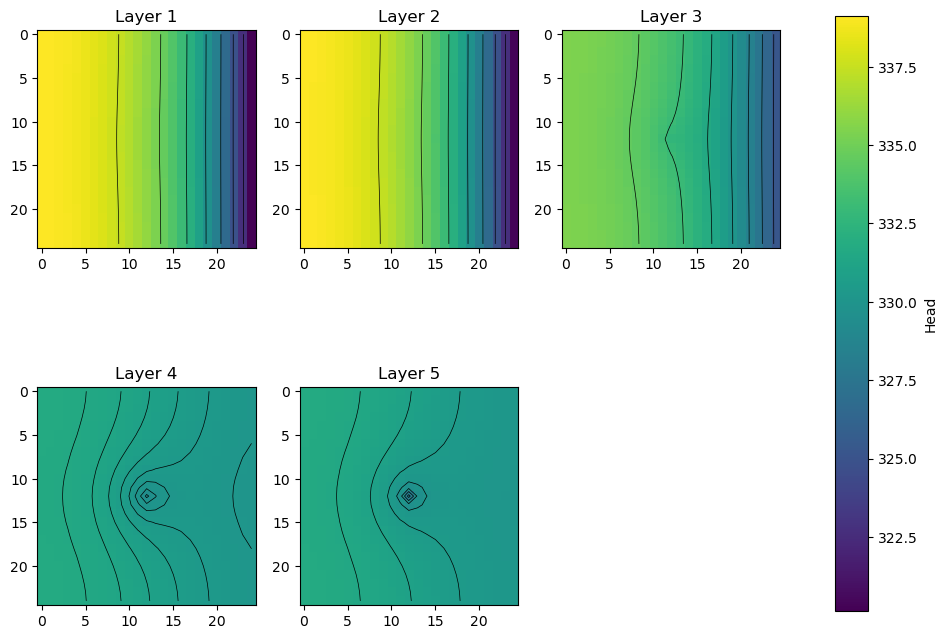
Plot heads in each layer; export the heads and head contours for viewing in a GIS
for more information about GIS export, type help(export_array), for example
[5]:
fig, axes = plt.subplots(2, 3, figsize=(11, 8.5))
axes = axes.flat
grid = m.modelgrid
for i, hdslayer in enumerate(hds):
    im = axes[i].imshow(hdslayer, vmin=hds.min(), vmax=hds.max())
    axes[i].set_title(f"Layer {i + 1}")
    ctr = axes[i].contour(hdslayer, colors="k", linewidths=0.5)

    # export head rasters
    # (GeoTiff export requires the rasterio package; for ascii grids, just change the extension to *.asc)
    flopy.export.utils.export_array(
        grid, os.path.join(workspace, f"heads{i + 1}.tif"), hdslayer
    )

    # export head contours to a shapefile
    flopy.export.utils.export_array_contours(
        grid, os.path.join(workspace, f"heads{i + 1}.shp"), hdslayer
    )

fig.delaxes(axes[-1])
fig.subplots_adjust(right=0.8)
cbar_ax = fig.add_axes([0.85, 0.15, 0.03, 0.7])
fig.colorbar(im, cax=cbar_ax, label="Head")
/home/runner/micromamba/envs/flopy/lib/python3.12/site-packages/pyogrio/geopandas.py:917: UserWarning: 'crs' was not provided.  The output dataset will not have projection information defined and may not be usable in other systems.
  write(
/home/runner/micromamba/envs/flopy/lib/python3.12/site-packages/pyogrio/geopandas.py:917: UserWarning: 'crs' was not provided.  The output dataset will not have projection information defined and may not be usable in other systems.
  write(
/home/runner/micromamba/envs/flopy/lib/python3.12/site-packages/pyogrio/geopandas.py:917: UserWarning: 'crs' was not provided.  The output dataset will not have projection information defined and may not be usable in other systems.
  write(
/home/runner/micromamba/envs/flopy/lib/python3.12/site-packages/pyogrio/geopandas.py:917: UserWarning: 'crs' was not provided.  The output dataset will not have projection information defined and may not be usable in other systems.
  write(
/home/runner/micromamba/envs/flopy/lib/python3.12/site-packages/pyogrio/geopandas.py:917: UserWarning: 'crs' was not provided.  The output dataset will not have projection information defined and may not be usable in other systems.
  write(
[5]:
<matplotlib.colorbar.Colorbar at 0x7fbab97af6e0>
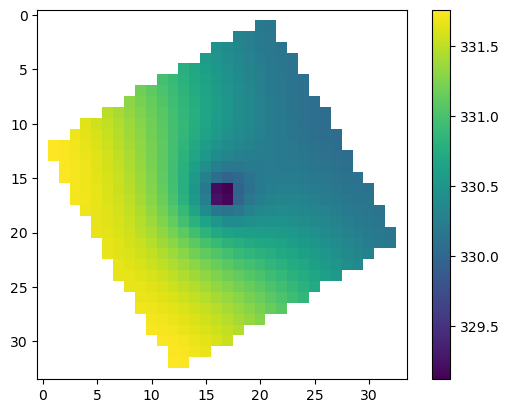
Compare rotated arc-ascii and GeoTiff output
[6]:
grid.set_coord_info(angrot=30.0)
nodata = 0.0
flopy.export.utils.export_array(
    grid, os.path.join(workspace, "heads5_rot.asc"), hdslayer, nodata=nodata
)
flopy.export.utils.export_array(
    grid, os.path.join(workspace, "heads5_rot.tif"), hdslayer, nodata=nodata
)

results = np.loadtxt(os.path.join(workspace, "heads5_rot.asc"), skiprows=6)
results[results == nodata] = np.nan
plt.imshow(results)
plt.colorbar()
[6]:
<matplotlib.colorbar.Colorbar at 0x7fbab929a660>
[7]:
try:
    import rasterio
except:
    rasterio = None
    print("install rasterio to create GeoTiff output")
if rasterio is not None:
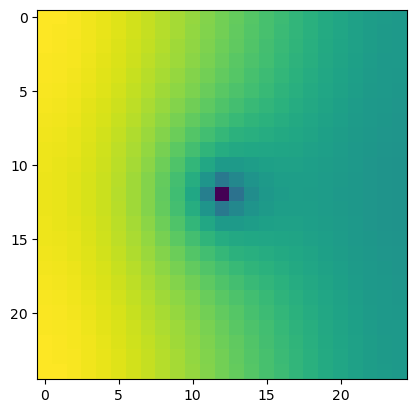
    with rasterio.open(os.path.join(workspace, "heads5_rot.tif")) as src:
        print(src.meta)
        plt.imshow(src.read(1))
{'driver': 'GTiff', 'dtype': 'float32', 'nodata': 0.0, 'width': 25, 'height': 25, 'count': 1, 'crs': None, 'transform': Affine(346.4101615137755, 199.99999999999997, -4999.999999999999,
       199.99999999999997, -346.4101615137755, 8660.254037844386)}
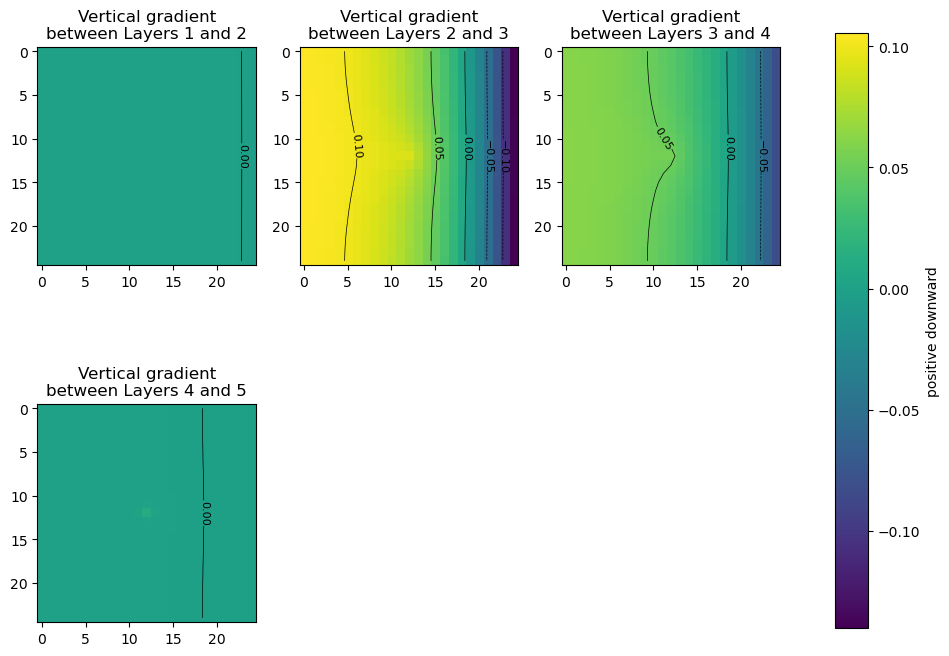
Get the vertical head gradients between layers
[8]:
grad = get_gradients(hds, m, nodata=-999)

fig, axes = plt.subplots(2, 3, figsize=(11, 8.5))
axes = axes.flat

for i, vertical_gradient in enumerate(grad):
    im = axes[i].imshow(vertical_gradient, vmin=grad.min(), vmax=grad.max())
    axes[i].set_title(f"Vertical gradient\nbetween Layers {i + 1} and {i + 2}")
    ctr = axes[i].contour(
        vertical_gradient,
        levels=[-0.1, -0.05, 0.0, 0.05, 0.1],
        colors="k",
        linewidths=0.5,
    )
    plt.clabel(ctr, fontsize=8, inline=1)

fig.delaxes(axes[-2])
fig.delaxes(axes[-1])
fig.subplots_adjust(right=0.8)
cbar_ax = fig.add_axes([0.85, 0.15, 0.03, 0.7])
fig.colorbar(im, cax=cbar_ax, label="positive downward")
[8]:
<matplotlib.colorbar.Colorbar at 0x7fbab96060f0>
Get the saturated thickness of a layer
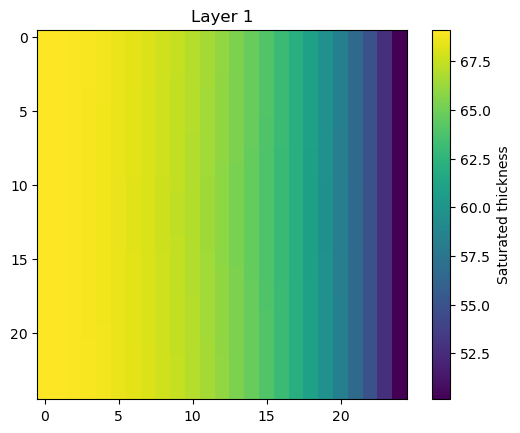
m.modelgrid.saturated_thickness() returns an nlay, nrow, ncol array of saturated thicknesses.
[9]:
st = m.modelgrid.saturated_thickness(hds, mask=-9999.0)

plt.imshow(st[0])
plt.colorbar(label="Saturated thickness")
plt.title("Layer 1")
[9]:
Text(0.5, 1.0, 'Layer 1')
Get the water table
get_water_table() returns an nrow, ncol array of the water table elevation. This method can be useful when HDRY is turned on and the water table is in multiple layers.
[10]:
wt = get_water_table(heads=hds, hdry=-9999)

plt.imshow(wt)
plt.colorbar(label="Elevation")
[10]:
<matplotlib.colorbar.Colorbar at 0x7fbab4fe6bd0>

Get layer transmissivities at arbitrary locations, accounting for the position of the water table
for this method, the heads input is an nlay x nobs array of head results, which could be constructed using the Hydmod package with an observation in each layer at each observation location, for example .
x, y values in real-world coordinates can be used in lieu of row, column, provided a correct coordinate information is supplied to the flopy model object’s grid.
open interval tops and bottoms can be supplied at each location for computing transmissivity-weighted average heads
this method can also be used for apportioning boundary fluxes for an inset from a 2-D regional model
see
**flopy3_get_transmissivities_example.ipynb**for more details on how this method works
[11]:
r = [20, 5]
c = [5, 20]
headresults = hds[:, r, c]
get_transmissivities(headresults, m, r=r, c=c)
[11]:
array([[3.42867432e+03, 2.91529083e+03],
       [2.50000000e+03, 2.50000000e+03],
       [1.99999996e-01, 1.99999996e-01],
       [2.00000000e+04, 2.00000000e+04],
       [2.00000000e+04, 2.00000000e+04]])
[12]:
r = [20, 5]
c = [5, 20]
sctop = [340, 320]  # top of open interval at each location
scbot = [210, 150]  # top of bottom interval at each location
headresults = hds[:, r, c]
tr = get_transmissivities(headresults, m, r=r, c=c, sctop=sctop, scbot=scbot)
tr
[12]:
array([[3.42867432e+03, 2.50000000e+03],
       [2.50000000e+03, 2.50000000e+03],
       [9.99999978e-02, 1.99999996e-01],
       [0.00000000e+00, 1.00000000e+04],
       [0.00000000e+00, 0.00000000e+00]])
convert to transmissivity fractions
[13]:
trfrac = tr / tr.sum(axis=0)
trfrac
[13]:
array([[5.78310817e-01, 1.66664444e-01],
       [4.21672316e-01, 1.66664444e-01],
       [1.68668923e-05, 1.33331553e-05],
       [0.00000000e+00, 6.66657778e-01],
       [0.00000000e+00, 0.00000000e+00]])
Layer 3 contributes almost no transmissivity because of its K-value
[14]:
m.lpf.hk.array[:, r, c]
[14]:
array([[5.e+01, 5.e+01],
       [5.e+01, 5.e+01],
       [1.e-02, 1.e-02],
       [2.e+02, 2.e+02],
       [2.e+02, 2.e+02]], dtype=float32)
[15]:
m.modelgrid.cell_thickness[:, r, c]
[15]:
array([[130., 130.],
       [ 50.,  50.],
       [ 20.,  20.],
       [100., 100.],
       [100., 100.]])
[16]:
try:
    # ignore PermissionError on Windows
    temp_dir.cleanup()
except:
    pass