Note
This page was generated from Notebooks/seawat_henry_example. Download as  .
.
a Jupyter notebook (.ipynb) or Python script (.py) or launch interactively with Binder .Henry Saltwater Intrusion Problem
In this notebook, we will use Flopy to create, run, and post process the Henry saltwater intrusion problem using SEAWAT Version 4.
[1]:
import os
import sys
from tempfile import TemporaryDirectory

import numpy as np

# run installed version of flopy or add local path
try:
    import flopy
except:
    fpth = os.path.abspath(os.path.join("..", ".."))
    sys.path.append(fpth)
    import flopy

print(sys.version)
print("numpy version: {}".format(np.__version__))
print("flopy version: {}".format(flopy.__version__))
3.8.17 (default, Jun  7 2023, 12:29:56)
[GCC 11.3.0]
numpy version: 1.24.4
flopy version: 3.4.2
[2]:
# temporary directory
temp_dir = TemporaryDirectory()
workspace = temp_dir.name
[3]:
# Input variables for the Henry Problem
Lx = 2.0
Lz = 1.0
nlay = 50
nrow = 1
ncol = 100
delr = Lx / ncol
delc = 1.0
delv = Lz / nlay
henry_top = 1.0
henry_botm = np.linspace(henry_top - delv, 0.0, nlay)
qinflow = 5.702  # m3/day
dmcoef = 0.57024  # m2/day  Could also try 1.62925 as another case of the Henry problem
hk = 864.0  # m/day
[4]:
# Create the basic MODFLOW model structure
modelname = "henry"
swt = flopy.seawat.Seawat(modelname, exe_name="swtv4", model_ws=workspace)
print(swt.namefile)

# save cell fluxes to unit 53
ipakcb = 53

# Add DIS package to the MODFLOW model
dis = flopy.modflow.ModflowDis(
    swt,
    nlay,
    nrow,
    ncol,
    nper=1,
    delr=delr,
    delc=delc,
    laycbd=0,
    top=henry_top,
    botm=henry_botm,
    perlen=1.5,
    nstp=15,
)

# Variables for the BAS package
ibound = np.ones((nlay, nrow, ncol), dtype=np.int32)
ibound[:, :, -1] = -1
bas = flopy.modflow.ModflowBas(swt, ibound, 0)

# Add LPF package to the MODFLOW model
lpf = flopy.modflow.ModflowLpf(swt, hk=hk, vka=hk, ipakcb=ipakcb)

# Add PCG Package to the MODFLOW model
pcg = flopy.modflow.ModflowPcg(swt, hclose=1.0e-8)

# Add OC package to the MODFLOW model
oc = flopy.modflow.ModflowOc(
    swt,
    stress_period_data={(0, 0): ["save head", "save budget"]},
    compact=True,
)

# Create WEL and SSM data
itype = flopy.mt3d.Mt3dSsm.itype_dict()
wel_data = {}
ssm_data = {}
wel_sp1 = []
ssm_sp1 = []
for k in range(nlay):
    wel_sp1.append([k, 0, 0, qinflow / nlay])
    ssm_sp1.append([k, 0, 0, 0.0, itype["WEL"]])
    ssm_sp1.append([k, 0, ncol - 1, 35.0, itype["BAS6"]])
wel_data[0] = wel_sp1
ssm_data[0] = ssm_sp1
wel = flopy.modflow.ModflowWel(swt, stress_period_data=wel_data, ipakcb=ipakcb)
henry.nam
[5]:
# Create the basic MT3DMS model structure
# mt = flopy.mt3d.Mt3dms(modelname, 'nam_mt3dms', mf, model_ws=workspace)
btn = flopy.mt3d.Mt3dBtn(
    swt,
    nprs=-5,
    prsity=0.35,
    sconc=35.0,
    ifmtcn=0,
    chkmas=False,
    nprobs=10,
    nprmas=10,
    dt0=0.001,
)
adv = flopy.mt3d.Mt3dAdv(swt, mixelm=0)
dsp = flopy.mt3d.Mt3dDsp(swt, al=0.0, trpt=1.0, trpv=1.0, dmcoef=dmcoef)
gcg = flopy.mt3d.Mt3dGcg(swt, iter1=500, mxiter=1, isolve=1, cclose=1e-7)
ssm = flopy.mt3d.Mt3dSsm(swt, stress_period_data=ssm_data)

# Create the SEAWAT model structure
# mswt = flopy.seawat.Seawat(modelname, 'nam_swt', mf, mt, model_ws=workspace, exe_name='swtv4')
vdf = flopy.seawat.SeawatVdf(
    swt,
    iwtable=0,
    densemin=0,
    densemax=0,
    denseref=1000.0,
    denseslp=0.7143,
    firstdt=1e-3,
)
[6]:
# Write the input files
swt.write_input()
[7]:
# Try to delete the output files, to prevent accidental use of older files
try:
    os.remove(os.path.join(workspace, "MT3D001.UCN"))
    os.remove(os.path.join(workspace, modelname + ".hds"))
    os.remove(os.path.join(workspace, modelname + ".cbc"))
except:
    pass
[8]:
v = swt.run_model(silent=True, report=True)
for idx in range(-3, 0):
    print(v[1][idx])
 Elapsed run time:  9.860 Seconds

 Normal termination of SEAWAT
[9]:
# Post-process the results
import numpy as np

import flopy.utils.binaryfile as bf

# Load data
ucnobj = bf.UcnFile(os.path.join(workspace, "MT3D001.UCN"), model=swt)
times = ucnobj.get_times()
concentration = ucnobj.get_data(totim=times[-1])
cbbobj = bf.CellBudgetFile(os.path.join(workspace, "henry.cbc"))
times = cbbobj.get_times()
qx = cbbobj.get_data(text="flow right face", totim=times[-1])[0]
qz = cbbobj.get_data(text="flow lower face", totim=times[-1])[0]

# Average flows to cell centers
qx_avg = np.empty(qx.shape, dtype=qx.dtype)
qx_avg[:, :, 1:] = 0.5 * (qx[:, :, 0 : ncol - 1] + qx[:, :, 1:ncol])
qx_avg[:, :, 0] = 0.5 * qx[:, :, 0]
qz_avg = np.empty(qz.shape, dtype=qz.dtype)
qz_avg[1:, :, :] = 0.5 * (qz[0 : nlay - 1, :, :] + qz[1:nlay, :, :])
qz_avg[0, :, :] = 0.5 * qz[0, :, :]
[10]:
# Make the plot
import matplotlib.pyplot as plt

fig = plt.figure(figsize=(10, 10))
ax = fig.add_subplot(1, 1, 1, aspect="equal")
ax.imshow(
    concentration[:, 0, :], interpolation="nearest", extent=(0, Lx, 0, Lz)
)
y, x, z = dis.get_node_coordinates()
X, Z = np.meshgrid(x, z[:, 0, 0])
iskip = 3
ax.quiver(
    X[::iskip, ::iskip],
    Z[::iskip, ::iskip],
    qx_avg[::iskip, 0, ::iskip],
    -qz_avg[::iskip, 0, ::iskip],
    color="w",
    scale=5,
    headwidth=3,
    headlength=2,
    headaxislength=2,
    width=0.0025,
)
plt.savefig(os.path.join(workspace, "henry.png"))
plt.show()

[11]:
# Extract the heads
fname = os.path.join(workspace, "henry.hds")
headobj = bf.HeadFile(fname)
times = headobj.get_times()
head = headobj.get_data(totim=times[-1])
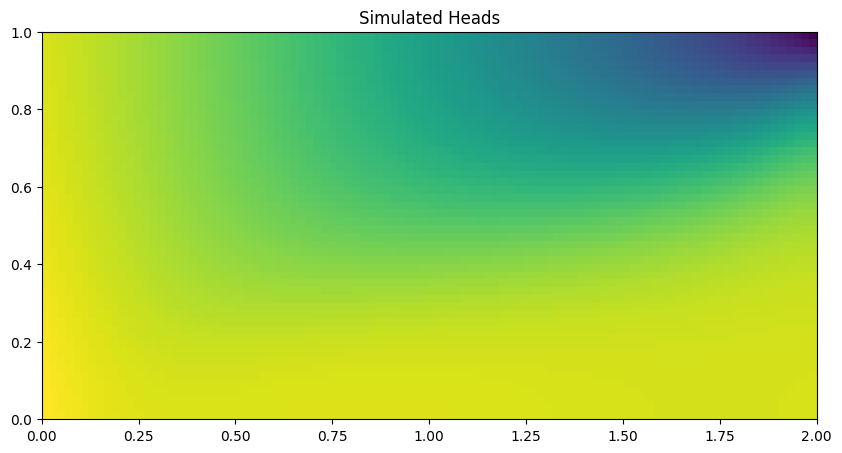
[12]:
# Make a simple head plot
fig = plt.figure(figsize=(10, 10))
ax = fig.add_subplot(1, 1, 1, aspect="equal")
im = ax.imshow(head[:, 0, :], interpolation="nearest", extent=(0, Lx, 0, Lz))
ax.set_title("Simulated Heads")
[12]:
Text(0.5, 1.0, 'Simulated Heads')
Change the format of several arrays and rerun the model
[13]:
swt.btn.prsity.how = "constant"
swt.btn.prsity[0].how = "internal"
swt.btn.prsity[1].how = "external"
swt.btn.sconc[0].how = "external"
swt.btn.prsity[0].fmtin = "(100E15.6)"
swt.lpf.hk[0].fmtin = "(BINARY)"
[14]:
swt.write_input()
v = swt.run_model(silent=True, report=True)
for idx in range(-3, 0):
    print(v[1][idx])
Util2d:hk layer 1: resetting 'how' to external
 Elapsed run time: 10.052 Seconds

 Normal termination of SEAWAT
[15]:
try:
    # ignore PermissionError on Windows
    temp_dir.cleanup()
except:
    pass